March 27, 2026
Real Estate Photography Tips: Take Better Listing Photos
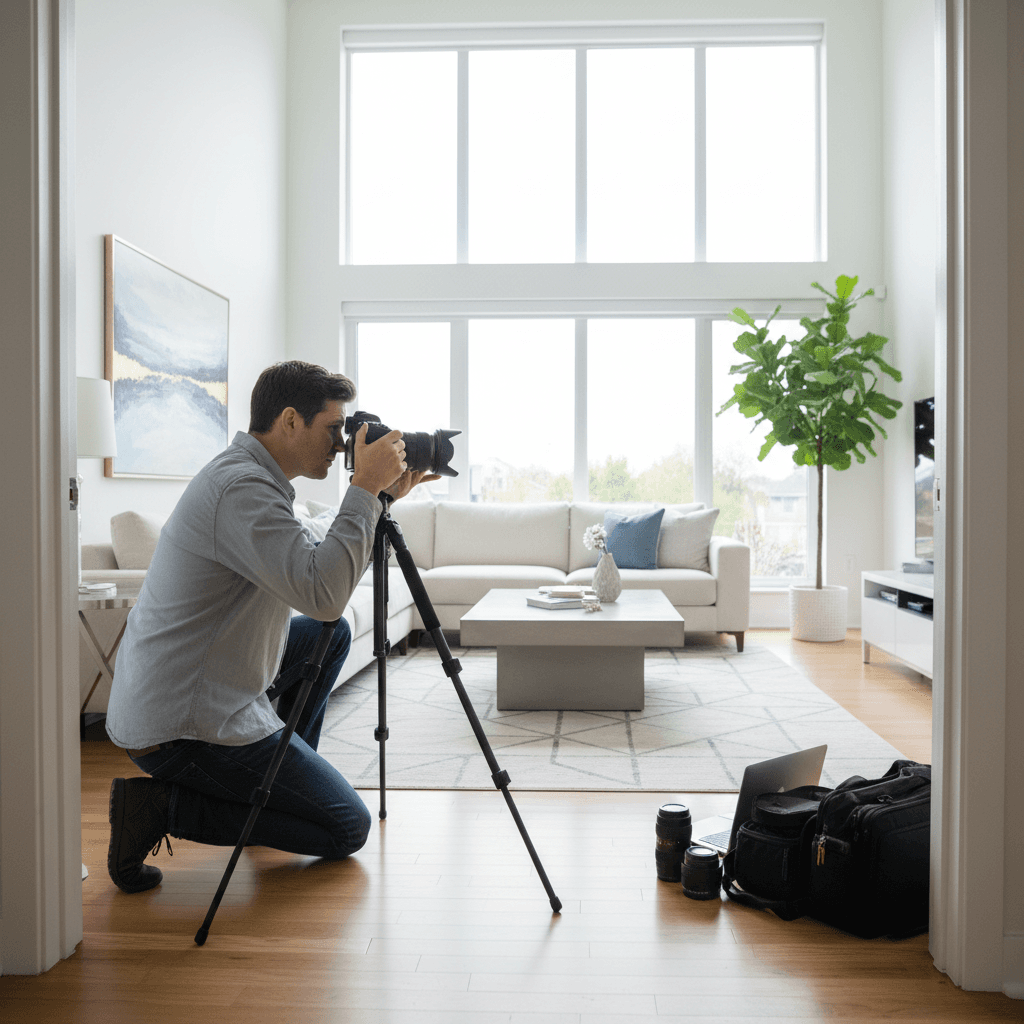
Good listing photos aren't optional anymore. Properties with professional-quality photos sell 32% faster and can command higher prices. Whether you're a professional photographer refining your craft or an agent who shoots your own listings, these tips will help you capture photos that attract buyers and generate showings.
Equipment Essentials
Camera body
Any modern DSLR or mirrorless camera with manual mode will work. You don't need the latest flagship body — a capable APS-C or full-frame camera from the last five years is plenty. What matters more is knowing how to use it.
Wide-angle lens
A wide-angle lens is non-negotiable for interiors. On a full-frame camera, a 16–35mm zoom or a 17mm prime works well. On APS-C, look at 10–18mm or 10–22mm zooms. The goal is to capture enough of each room to show its layout without extreme distortion.
A word of caution: going too wide (below 14mm on full-frame) creates barrel distortion that makes rooms look artificially large. Buyers feel deceived when they visit and the rooms seem smaller than the photos. Stick to 16–20mm equivalent for interiors.
Tripod
Always use a tripod. It lets you shoot at lower ISOs for cleaner images, keeps verticals straight, and ensures consistent framing. A tripod also enables bracketed exposures for HDR if you need them. Set your tripod height so the camera is about chest-height — roughly 4–5 feet — for the most natural perspective.
Camera Settings
Shoot in manual mode
Auto mode will produce inconsistent results room to room. Use manual mode so you control the exposure. Here are good starting settings for interiors:
- Aperture: f/7.1 to f/9. This keeps the entire room sharp from front to back.
- ISO: 200–400. Keep it as low as possible for clean, noise-free images.
- Shutter speed: Varies — let this adjust based on available light. Since you're on a tripod, slow shutter speeds are fine.
- White balance: Set to a fixed Kelvin value (around 5000–5500K) so all your photos match. Don't rely on auto white balance, which shifts unpredictably.
Shoot RAW
Always shoot in RAW format, not JPEG. RAW files give you far more latitude in post-processing to recover highlights, lift shadows, and correct white balance. The files are larger, but the editing flexibility is worth it.
Lighting
Use natural light as your primary source
Turn off all interior lights before you start — especially ones with warm bulbs that create mixed color temperatures. Open every blind and curtain. Let natural light fill the room. The result is cleaner, more consistent images with accurate colors.
The exception: if a room has no windows or very limited natural light, you'll need the interior lights on. In that case, try to make sure all bulbs in the room are the same color temperature.
Time of day matters
Shoot interiors from late morning to early afternoon, when the sun is high and natural light is even. Avoid late afternoon when direct sunlight streams through windows and creates harsh contrast.
For exterior shots, the best time depends on which direction the property faces. You want the sun illuminating the front of the house, not behind it. Golden hour (the last hour before sunset) produces warm, flattering exterior photos but can be tricky for interiors.
Manage window blow-out
The biggest challenge in real estate photography is the dynamic range between bright windows and darker interiors. You have three options:
- Expose for the interior and accept blown-out windows (most common approach for speed).
- Bracket your exposures and merge them in post (2–3 exposures, 2 stops apart).
- Use flash to fill the interior and balance the exposure with the windows.
For most listings, exposing for the interior and fixing minor issues in post-processing is the fastest workflow. If you're shooting higher-end listings, bracketing gives you the best results.
Composition
Shoot from corners and doorways
Position yourself in a corner or doorway to capture the maximum amount of the room in a single frame. This gives buyers the best sense of the room's size and layout. Shooting straight at a wall flattens the space and makes it look smaller.
Keep verticals straight
Tilting the camera up or down creates converging vertical lines that look unprofessional. Keep the camera level — this is where a tripod with a bubble level helps. You can fine-tune verticals in post-processing if needed.
Include some foreground
When shooting a room, include a bit of foreground — the edge of a counter, a piece of furniture — to give the photo depth. Images with only mid-ground and background feel flat.
Shoot every room
Buyers want to see every room, including bathrooms, laundry rooms, and the garage. Skipping rooms makes buyers suspicious about what you're hiding. Even small rooms deserve at least one well-composed shot.
Post-Processing Workflow
Even well-shot photos benefit from post-processing. Here's a typical editing workflow:
- Lens correction — Remove barrel distortion and chromatic aberration.
- Exposure and white balance — Adjust brightness and color temperature for consistency.
- Vertical correction — Straighten any leaning walls.
- Shadow and highlight recovery — Open up dark areas and pull back blown highlights.
- Crop and straighten — Clean up the frame.
- Export — Output at high resolution for MLS and web.
If you want to speed up this process, photo editing tools can handle steps 2 through 5 automatically. Run your photos through ListingScene's enhancement tool and you'll get consistent, well-balanced results in seconds — no manual slider adjustments.
Don't forget exterior photos
If you shot exteriors under overcast skies, consider using sky replacement to swap in a blue sky. It's a small enhancement that significantly improves curb appeal in listing photos.
Final Thoughts
Great real estate photography comes down to three things: a wide-angle lens, good natural light, and consistent post-processing. Master those fundamentals and every listing you shoot will look professional.
For the post-processing step, ListingScene can save you hours per week by automating the routine edits. That frees you up to focus on what matters most — shooting more properties and growing your business.